 Stakestone
 Yield Assets and Payment Infrastructure
Stakestone connects ETH staking yield, BTC and stablecoin strategies, personal accounts and programmable payments within a crypto finance network. Its 2.0 design combines self-custodied accounts with a yield layer spanning decentralized protocols and custodial execution. ETH returns come from staking and restaking; BTC and stablecoin strategies involve different asset-management arrangements. STONE, STONEBTC and STONEUSD represent distinct yield exposures, while SBTC focuses on BTC liquidity. Personal accounts add social login and gas handling, and the agent-payment architecture adds programmable authorization. Control of an account, access to underlying assets and the price of a transferable token each follow their own conditions.
Account self-custody and underlying asset custody remain separate, so each yield product carries its own pricing, access and redemption conditions.
Different jobs for accounts and yield tokens
A payment account controls access and transfers, while a yield token represents exposure to an underlying strategy. An account can hold a token without controlling the custodian or protocol managing its backing. Likewise, a transferable token can offer market liquidity even when direct redemption follows a processing cycle. The account layer handles access and payment operations; the yield layer connects assets to strategies and records their value.
Stone Wallet brings holding, sending, receiving and payment functions together with yield access. The Earn module covers STONE for ETH, STONEBTC for BTC and STONEUSD for stablecoins.
How do ETH, BTC and stablecoins generate yield?
ETH generates yield through staking and restaking, while the 2.0 model uses custodially managed, market-neutral strategies for BTC and stablecoins.
ETH and STONE
STONE is the ETH yield-bearing token. Deposited ETH enters a vault before deployment into underlying strategies; the minter issues STONE using the contract exchange rate. Its non-rebasing design reflects accrued yield in the ETH value per token, without adding tokens to a holder’s balance. Restaking compatibility comes from integrating restaked underlying assets into the strategy pool. STONE itself does not have to become the asset used for restaking. OPAP governs strategy selection and allocation, so the exposure follows the portfolio’s composition rather than one permanently fixed staking route.
BTC liquidity and STONEBTC
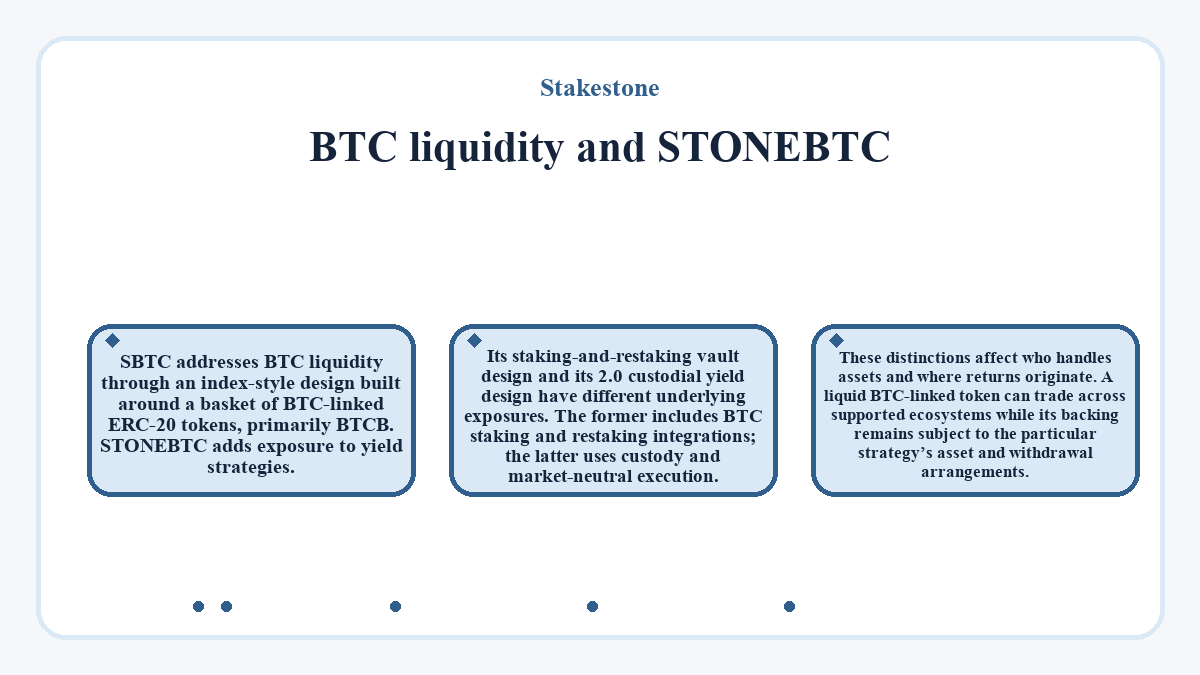
SBTC addresses BTC liquidity through an index-style design built around a basket of BTC-linked ERC-20 tokens, primarily BTCB. STONEBTC adds exposure to yield strategies. Its staking-and-restaking vault design and its 2.0 custodial yield design have different underlying exposures. The former includes BTC staking and restaking integrations; the latter uses custody and market-neutral execution. These distinctions affect who handles assets and where returns originate. A liquid BTC-linked token can trade across supported ecosystems while its backing remains subject to the particular strategy’s asset and withdrawal arrangements.
Stablecoin strategies and STONEUSD
STONEUSD represents a share in a portfolio of market-neutral strategies, including arbitrage on centralized exchanges. Market-neutral strategies seek returns from market relationships while limiting directional price exposure. Fund performance changes the contract exchange rate. An annual percentage yield describes returns on an annualized basis; it does not fix the token’s future value. The portfolio can change with market conditions and risk controls, and its exchange rate can fall when underlying performance deteriorates.
Contract value and secondary-market liquidity
STONE’s contract rate reflects underlying asset value divided by total STONE supply; exchange liquidity determines its trading price. STONEUSD’s contract exchange rate supplies the valuation used for permissioned minting and redemption. Secondary-market swaps use a market quote, which may differ because of supply, demand and available liquidity. STONEUSD supports permissionless secondary-market trading. Direct minting and redemption require identity checks and whitelist approval. The service also applies geographic and sanctions restrictions, so permissionless trading mechanics do not establish universal eligibility to access its interface.
Direct STONEUSD redemptions normally follow weekly processing. Asset availability, operational incidents or market stress can delay or suspend redemption; a market sale follows separate liquidity conditions.
Personal account access and payments
Personal accounts combine social sign-in with payment functions, including email-based sending and scan-to-pay.
Social login and account controls
Email, Google and X sign-in provide access without requiring a user-managed seed phrase for the social-login experience. The 2.0 account design uses account abstraction to add programmable operations to blockchain accounts. Authentication identifies access to an account, while a payment authorization governs an action. Linking a social identity to financial activity also creates privacy considerations beyond the protection of wallet keys.
Gas handling and service costs
Gas handling removes the need to manage network fees manually in the supported personal-account experience. The architecture uses relayers or sponsorship to handle those costs. STONEUSD interactions have separate cost rules: platform charges may affect the exchange rate, direct redemptions may carry a disclosed fee and swap providers charge their own fees. The STONEUSD terms make users responsible for blockchain fees on direct protocol and swap transactions. Gas abstraction therefore describes how a supported transaction handles fees; it does not establish that every asset operation costs nothing.
AP2 and controlled machine payments
Agent payments depend on identity and authorization within the 2.0 architecture. AP2, the Agent Payments Protocol, expresses payment intent: what an agent has permission to pay and under which conditions. The design also incorporates x402 for payment authorization and settlement. This connects an agent’s task to a payment mechanism without treating an instruction as completed settlement. The amount and recipient remain part of the authorized payment context, which limits the action’s scope.
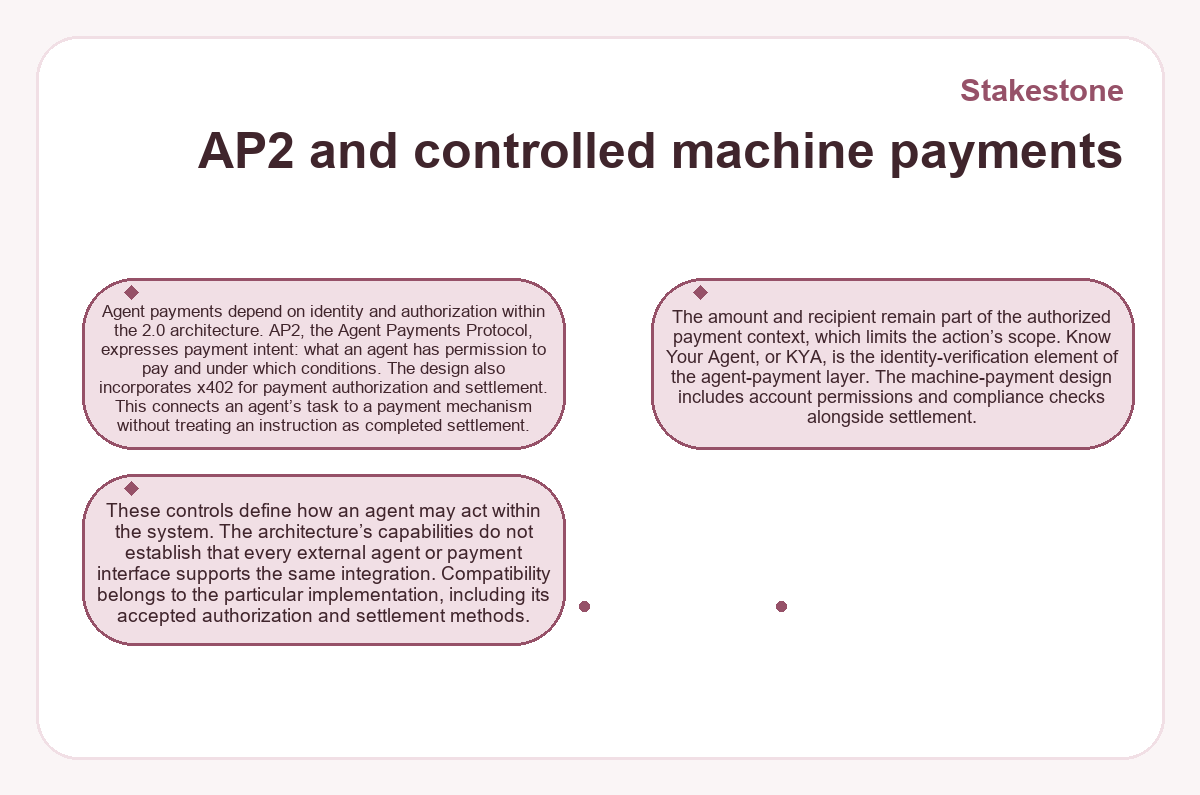
Know Your Agent, or KYA, is the identity-verification element of the agent-payment layer.
The machine-payment design includes account permissions and compliance checks alongside settlement. These controls define how an agent may act within the system. The architecture’s capabilities do not establish that every external agent or payment interface supports the same integration. Compatibility belongs to the particular implementation, including its accepted authorization and settlement methods.
OPAP allocations and ecosystem incentives
OPAP manages changes to STONE’s underlying portfolio through proposals. Its name expands to Optimizing Portfolio and Allocation Proposal. The mechanism covers adding strategies and changing the distribution of ETH among them. That flexibility can alter the sources of yield and the risks holders face. Market liquidity, counterparties and contract or oracle reliability remain relevant when the allocation changes. Governance determines an accepted adjustment; it does not make the resulting portfolio immune to those exposures.
STO supports broader protocol governance through the vote-escrowed form veSTO. Holders of locked veSTO vote on incentive allocation and protocol parameters through a process separate from STONE’s portfolio governance.
LiquidityPad extends the liquidity infrastructure to project-specific pre-deposit vaults and capital distribution across ecosystems. Liquidity providers can gain project incentives alongside other yield opportunities. Those incentives belong to the relevant vault or program; they are separate from the underlying return of an ETH or BTC strategy. This also distinguishes providing liquidity to an ecosystem from merely holding a yield-bearing token.
Does a self-custodied account remove custodial exposure?
A self-custodied account does not remove the custodial exposure of assets committed to external yield strategies. The 2.0 yield architecture uses custodial infrastructure for STONEBTC and STONEUSD. Holding the resulting token in a controlled wallet leaves those underlying dependencies in place. For STONEUSD, custodian or exchange disruptions can affect rate updates and redemption processing. A market-neutral position remains exposed to unsuccessful execution and counterparty failures. ETH strategies involve their own protocol and smart-contract dependencies. The relevant protection depends on where the asset sits and which mechanism controls its return.
Reserve checks and software audits
Custodian attestations address backing assets, while software audits examine a defined implementation. Stakestone has product-specific audits covering STONEUSD, STONE, SBTC and STONEBTC. An audit’s scope and reviewed code matter because another contract version can introduce different behavior. An attestation addresses custody evidence within its own scope; it does not settle how a strategy will perform or how quickly every asset can exit.
Onchain records expose token values and settlements, but externally managed strategies also rely on custody and execution systems. A visible exchange-rate update is an accounting event, not an assurance of immediate redemption. These records support transparency alongside the separate controls governing asset movement. Contract review and backing evidence answer complementary questions, and neither removes the liquidity and counterparty conditions attached to the product.
A choice based on asset control and access
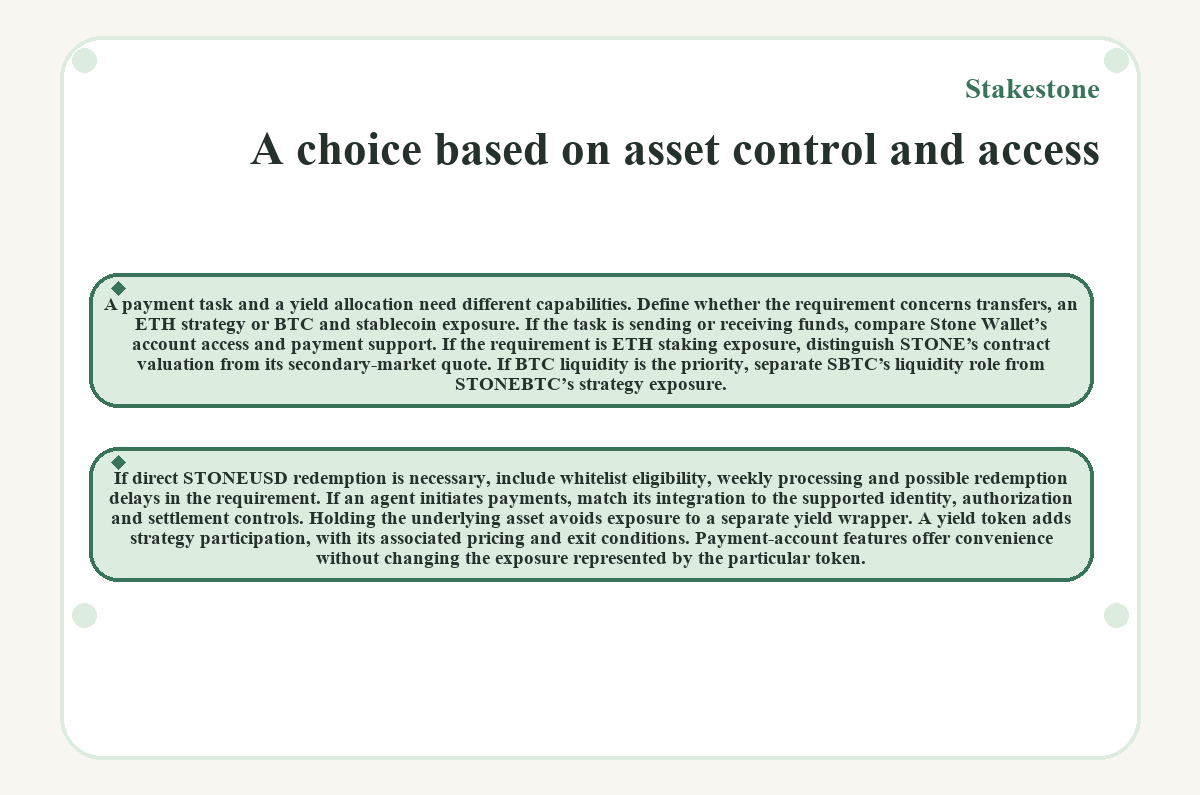
A payment task and a yield allocation need different capabilities. Define whether the requirement concerns transfers, an ETH strategy or BTC and stablecoin exposure.
- If the task is sending or receiving funds, compare Stone Wallet’s account access and payment support.
- If the requirement is ETH staking exposure, distinguish STONE’s contract valuation from its secondary-market quote.
- If BTC liquidity is the priority, separate SBTC’s liquidity role from STONEBTC’s strategy exposure.
- If direct STONEUSD redemption is necessary, include whitelist eligibility, weekly processing and possible redemption delays in the requirement.
- If an agent initiates payments, match its integration to the supported identity, authorization and settlement controls.
Holding the underlying asset avoids exposure to a separate yield wrapper. A yield token adds strategy participation, with its associated pricing and exit conditions. Payment-account features offer convenience without changing the exposure represented by the particular token.
Common questions about Stakestone
Does a Google login replace the checks for direct STONEUSD minting?
A Google login does not replace identity verification and whitelist approval for direct STONEUSD minting. Sign-in provides account access; permissioned minting requires separate know-your-customer or know-your-business checks and anti-money-laundering procedures. Secondary-market swaps follow a different access model and use market pricing, so account authentication alone does not grant direct protocol access.
What happens if nobody votes on an OPAP proposal?
OPAP does not implement a proposal when nobody votes for or against it. Approval requires more affirmative votes than opposing votes at the end of the public notice period. Voting weight depends on how much STONE participants lock.
Can STONEUSD move between supported blockchains?
STONEUSD can move between supported blockchains through its bridge functionality. Multi-chain availability applies to supported deployments, rather than every network. Moving the token changes where it can be held or traded; it does not turn a secondary-market swap into permissioned minting or remove the custody dependencies of the underlying portfolio.
Is STO designed to maintain a fixed currency value?
STO is not designed to maintain a fixed value against a currency or asset. It supports governance and ecosystem incentives, so its economic role differs from the ETH yield exposure of STONE. Conversion into veSTO and participation in governance do not make STO a stablecoin or give it a fixed exchange rate.
Which personal data can Stakestone collect when a wallet connects?
Stakestone may collect wallet identifiers, associated transaction history and technical access data when its services are used. The categories also include IP addresses, device information and location data. Information supplied for particular services can include contact details and identity records. Self-custody concerns control of assets; it does not prevent service providers from processing personal information.
updated